



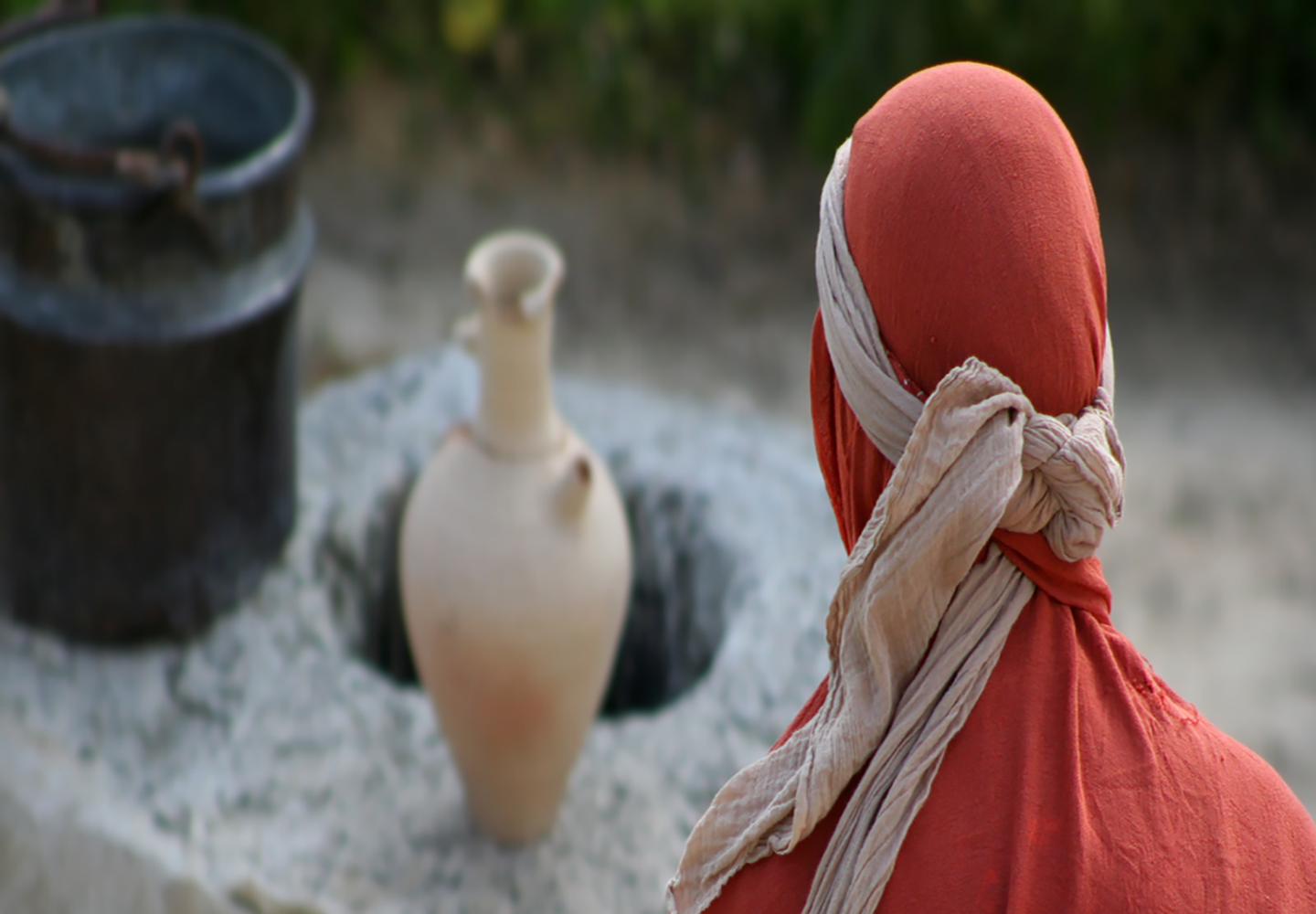

"Jesus asked her, 'Woman, why are you crying? Who are you looking for?' Thinking he was the gardener, she said, 'Sir, if you have carried him away, tell me where you have put him, and I will get him.' Jesus said to her, 'Mary!' She turned and said to him in Aramaic, 'Rabboni!' (which means 'Teacher')." (Gospel of John, chapter 20, verses 15-16*)
Along with the twelve apostles who followed Christ closely day after day for more than three years, there were 'some women who had been healed of evil spirits and diseases: Mary, called Magdalene, from whom seven demons had come out.' (Gospel of Luke, chapter 8, verse 2*) In addition to her, Joanna, Susanna, and others are mentioned. These women are said to be with the Messiah through all the stages of his momentous mission—from his arrest, through the crucifixion, during the burial, and after that at the resurrection.
Mary Magdalene is the most frequently mentioned name among these women and indeed among biblical heroines for a reason. In fact, she is the first person to whom Jesus appears after his resurrection. Why is that? Does God have favorites? Why did He choose to appear first to a woman, not to a man? Do all these details really matter?
There are all sorts of speculations about the image of Mary Magdalene, and we ourselves can take many different directions in our reflections on her. Perhaps what we should focus on most is not to whom exactly, but to what kind of person Jesus first appeared following his resurrection.
A specific feature, also mentioned by Dr. Luke in his gospel, is related to Mary Magdalene's past. Jesus delivered her from seven demons, which became known to all who knew her and those with whom she followed Christ. Regardless of the time and circumstances, being freed from demons, which apparently has its visible manifestations, cannot leave others indifferent towards you. At the very least, you will always be remembered as the one 'who was freed from demons.' The Apostle Paul has his own explanation concerning different believers who build the body of Christ on earth. He compares each one of us to a body part—together forming one body. Regarding people whom we are inclined to underestimate or devalue (even if we have real arguments for it), the apostle says: 'God has arranged the body so that greater honor is given to the part that lacks it, so that there should be no division in the body, but its parts should have equal concern for each other.' (1 Corinthians, chapter 12, verses 24b-25*) In His great love and justice, God does not allow everyone to look at Mary Magdalene merely as the woman freed from demons. In fact, He shows favor towards her, and today we know her as the first person to see Jesus Christ following His resurrection.
However, following her deliverance, we see that Mary Magdalene begins to live a completely different life, dedicating all she has to God—resources, time, and even her life. When Jesus is sentenced and led to Golgotha to be crucified, the women, along with Mary Magdalene, follow the procession. They are with Him in His death, and after He expires: "Mary Magdalene and Mary, the mother of Joses, saw where He was laid." (Gospel of Mark, chapter 15, verse 47*) In fact, these two women know where Joseph of Arimathea laid the Messiah's body, because they are there at the place.
What strength is needed to watch how, in the most torturous way, a dear person dies, the greatest hero in your eyes? Especially when you expected the exact opposite—that this person would become king, liberate you from the oppressor, defeat the Roman legions, and lead a nationwide uprising and renewal movement. We do not know what exactly Mary Magdalene believed about the person of Jesus at that moment, but we can see in her actions strength and faith, not despair, disappointment, or fear. She does not hide like many other followers of Christ at that time. She does not abandon Him, believing that He had deceived and misled her.
She is faithful—a loyal friend who will do everything necessary to care for her Teacher even after His death.
Why does Mary Magdalene possess such loyalty? We often mistakenly believe that loyalty is a trait that some people have and others lack. Loyalty is actually not a characteristic inherent to any person. Scripture says it is part of the fruit of the Spirit. 'But the fruit of the Spirit is love, joy, peace, patience, kindness, goodness, faithfulness, gentleness, self-control. Against such things there is no law.' (Galatians, chapter 5, verses 22-23*, the bold text is ours) The word used in Greek here is pistis, which translates as faith or faithfulness, as visible in other translations. It literally means to be convinced by someone of something.
So convinced that when your eyes see the exact opposite, they do not accept it as truth. So confident in the truth of something that the pain, fear, horror, and hopelessness of death do not move or shake you.
That is why we see this incredible strength and loyalty in Mary Magdalene—she is actually a person fully convinced in the words of her Savior, because she experienced her own personal healing, deliverance, and resurrection. She knows where she comes from, so she is not afraid of death. Death in her life was followed by resurrection.
What we can learn from the person of Mary Magdalene is the following:
- not to try on our own strength to develop or exhibit any good traits, but to turn to the One who can fully redeem our past
- strength often manifests itself in just being there, next to the person in need—crying, laughing, carrying with them
- not to try to hide our past, but boldly share the miracle of divine change, even if remembered as the one from whom 'God drove out seven demons'
*Biblical quotes are according to the text of Bible, new translation from the original languages © Bulgarian Bible Society 2013.