


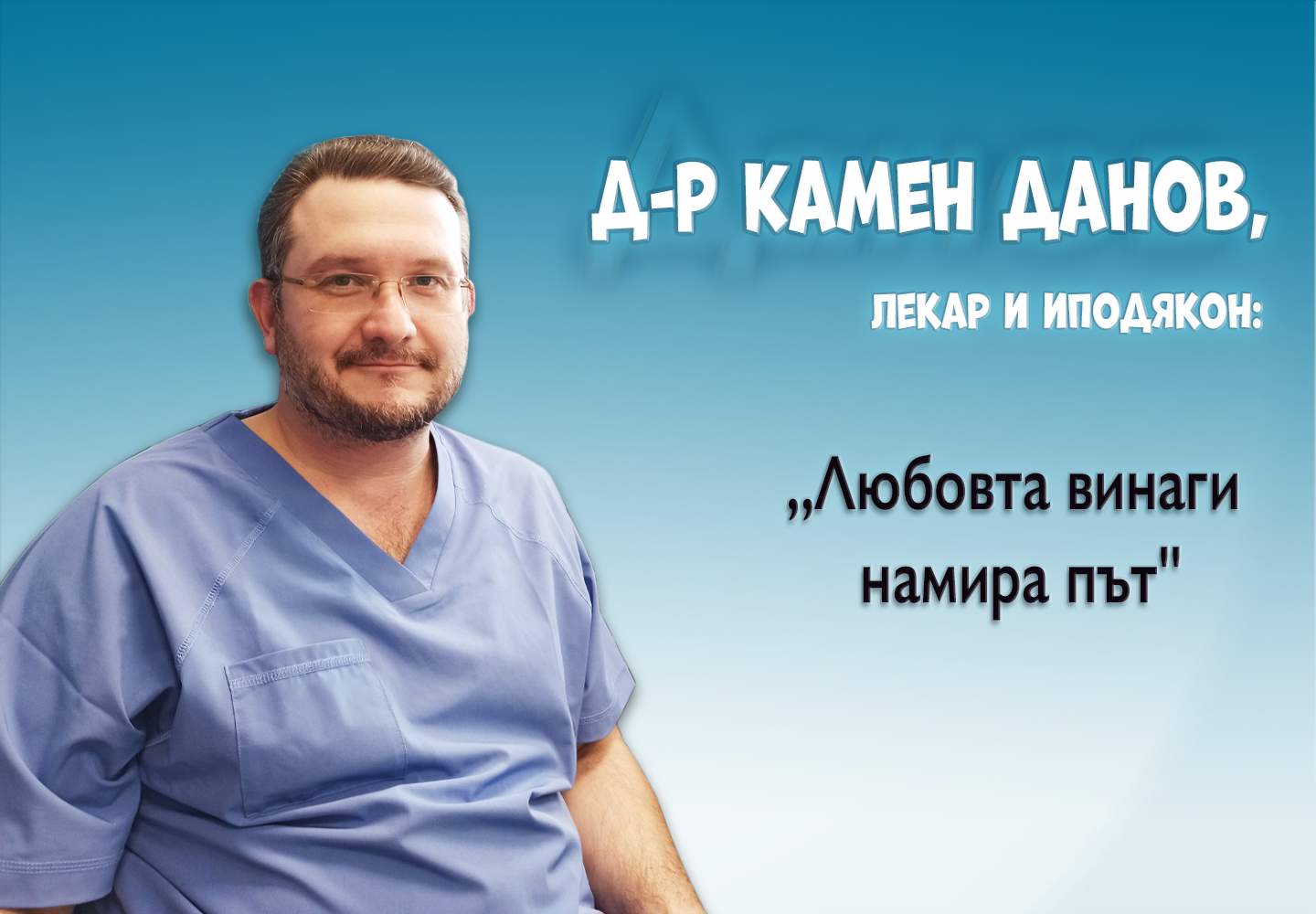
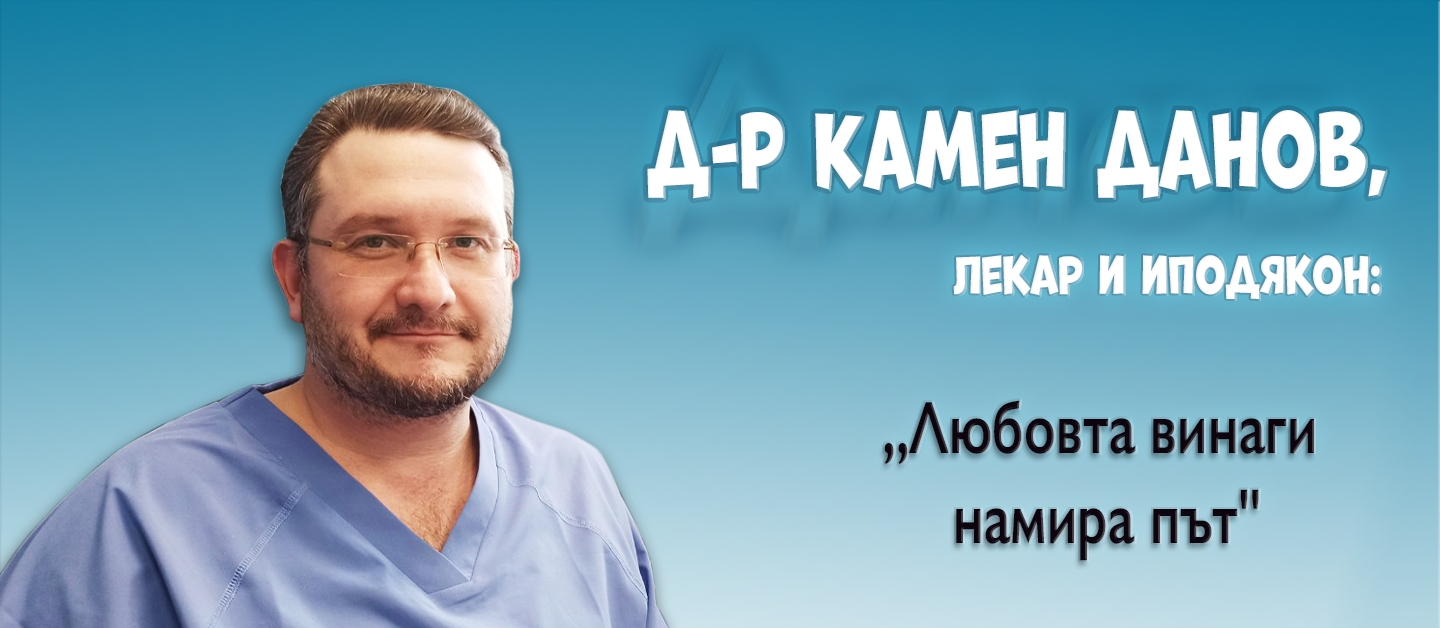
Conversation with Dr. Kamen Danov, head of the Gastroenterology Department at Pirogov University Hospital for Emergency Medicine, currently a member of the diocese council of the Sofia Metropolis and a subdeacon at the Sofia church "St. George the Victorious."
Why did you decide to become a doctor?
My family includes medics on both my father’s and mother’s side. As a child, when I would go after school to pick up my mother from work or during the summers when my grandmothers would take care of me, I saw this type of work, the people waiting and those being helped. It seemed appealing to me. It didn’t put me off, even though I saw the hope and pain in people waiting to be admitted to the hospital. I decided that this should probably be my path as well. On rare occasions have I thought differently. After university, I briefly inclined towards working as a surgeon, but decided I wanted to be involved in something that requires more thought, without offending anyone.
Weren’t you daunted by the path you decided to take? How did you prepare yourself for the weight of responsibility?
At times it frightened me, but since childhood, I've been taught to be responsible for everything I do. A fundamental principle in medicine is to do no harm - primum non nocere (from Latin, "First, do no harm"). It's interesting that those who established these principles in pagan times, even Hippocrates himself, came to the conclusion that a doctor should not participate in abortions, murders, poisonings, nor take advantage of people in helpless states. These principles remain relevant.
And if one adheres to them, there is nothing to worry about.
Yes. There’s always the question, however, of whether it is the best decision at the moment. Since medicine is an evolving science, it is both a science and an art. Almost no treatment and therapy exist without side effects. Thus, the decision is really difficult and involves responsibility. The ultimate result shows whether it was made correctly though. If one adheres to these principles, the outcome is almost always good. But we must know that with or without the presence of doctors, people are mortal and die. The question is when and with what quality of life they will live. That is precisely where the physician can intervene.
What was the moment when God reached out to you, or was it not a moment but a process?
I would say it is a process, not a single act. Various encounters and situations have made me think. My literature teacher in eighth grade was the first person who talked to me systematically about God, with theological culture. This woman awakened our interest as students. Over the years, I’ve met various people who’ve told me things that preoccupy them. They’ve shared things with me that had an impact. So, it’s not a single act.
Many of us believe in God, but not everyone takes up church service. You are a subdeacon, how did you decide to dedicate yourself to the service of God?
I've always been interested in the mysticism of church services. A subdeacon is a layperson who is a reader, singer, and candle bearer. The symbolism in the service has attracted me even out of curiosity. Gradually, I began reading books, including the three volumes "Our Faith," "Our Hope," and "Our Love." Subsequently, the commitment to the Alexander Hospital temple arose. At that time, it was not yet finished, a blessing ceremony had been performed, and the building was open for people to enter, pray, and light a candle. I realized many expressed the need for such a temple on the hospital grounds. I began making inquiries; something clearly pushed me then. I saw that before the coup on September 9, 1944, many hospitals in Bulgaria had temples. For example, the temple in the Starozagorska Hospital was deliberately turned into a morgue. Thus, I decided that I could somehow help patients outside my work as a physician.
Do you separate the spiritual from the medical help?
In a purely medical setting, I don’t talk about the other aspect with people I don’t know well. Otherwise, it’s hard to separate them, as faith is a way of life. One carries it within oneself at every step of daily life. Initially, I was struck by surgical colleagues who cross themselves before entering surgery, say a prayer. I wondered. Initially, it was interesting to me why it's like that. Gradually, you realize it's a part of life, a way of living. So there probably isn't a dividing line, but for the general audience, there is (laughs).
Many still do not accept the spiritual. Recently, I was extremely surprised by a colleague who, in an unprofessional and even inhumane manner, made a comment like: "What kind of priest is among the first vaccinated?" referring to Bishop Tikhon. The bishop himself first worked many years as a paramedic, and once ordained as a bishop, expressed a desire to show by personal example that vaccination does not harm spirituality. It is a personal choice and cannot harm the Orthodox faith. Unfortunately, there are such colleagues whom I would not call doctors.
You mean intellect without spirituality does not work?
Not at all. I remember, as a trainee, I was on a rheumatology course, and Prof. Kolarov, one of the finest Bulgarian rheumatologists, told us: "I do not charge a fee to patients who carry spirituality within them and work in the field of culture." Writers, artists, musicians, people who strive to make others better. This statement strongly impressed me then. One is influenced by such people. The holiday of the enlightening figures is no coincidence, because such actions make one an enlightener, and the mere act of showing attitude toward the enlightener makes one so too. Meeting with people like Prof. Kolarov is not random. It is providence, and these people influence you. They make you think about their actions, with their spoken reflections.
That was one of my questions. Who is that person in your life who exemplifies living with love in action?
The most interesting thing is that I think of many people. I've been fortunate to meet many such people, and in some way, they’ve relaxed or allowed me to see what they do. With some, we’ve not been close at all, but they've decided to share their views. The more I think about it, the more such people come to mind. I'm even afraid to list them because I might miss someone.
And what is common among them? What is it in them that you wish to have in yourself?
That they quietly, without much talk, do what they have decided to do. They do not blare it to be understood. But in some way, I simply observed or they shared casually, yet precisely because it was casual, it made an impression on me. Literally, the left hand doesn't know what the right hand is doing (Matthew 6:3).
This past year has been tough for all of us, perhaps especially for doctors. What was the biggest challenge you faced in showing love over the past year?
The hardest was the denial by a large part of society. There were calls to see that when entering a COVID department, it’s empty, while people were actually working tirelessly. Colleagues from night shifts stayed to help daytime ones, and vice versa, without anyone making them. When I think about it, all that "hate" is outweighed by the gratitude from patients and their relatives. There are people I've treated whom I'll never forget. Some unfortunately passed away. Others got back on their feet and went home healthy. Among them were those who told me they’d never forget our medical team either. It was most beautiful when Mr. Ivan Pramatarov, the protopsal of the Bulgarian Orthodox Church, happened to be in the hospital and on December 25 congratulated our entire team with the troparion and kondak of Christmas. I saw what it means for a person to show love to those who've shown love to him, for taking care of him.
To give, one must have it within; where do you draw from so you can give?
Many leave without saying goodbye, but not by coincidence, from ten people appears one who stays, because he understands and appreciates what has been done. And that one is enough, who will say: "I see that you went beyond, talked to me, gave me courage, explained to me that everything will be okay." One out of ten is enough to energize you and make you think that it’s worth it. That person practically becomes your neighbor. Which was the neighbor in the parable of the Good Samaritan (Luke 10:36-37)? The one who showed him mercy. However, we're not sure whether the one who left didn't go home and later reflect. Even years later, this may bear fruit, we don’t know.
In conclusion, what are the three words you would use to describe Christ’s love, true love?
It is tangible, non-material energy, all-encompassing. It always finds a way to us. The love of Christ is like water, it finds a way, it finds a path.
Interviewer: Yoanna Ruseva
Photo: personal archive
Graphic processing: Kiril Veselinski
Post comment
«1»